<?xml version="1.0" encoding="utf-8"?><feed xmlns="http://www.w3.org/2005/Atom" ><generator uri="https://jekyllrb.com/" version="3.10.0">Jekyll</generator><link href="https://doublefree.in/feed.xml" rel="self" type="application/atom+xml" /><link href="https://doublefree.in/" rel="alternate" type="text/html" /><updated>2026-07-12T08:54:00+00:00</updated><id>https://doublefree.in/feed.xml</id><title type="html">Doublefree</title><subtitle>True progress arises from systems that are both liberating and regenerative</subtitle><author><name>Doublefree Team</name><email>doublefreein+join@gmail.com</email></author><entry><title type="html">Jump Into the Terminal — Let Students Explore First</title><link href="https://doublefree.in/education/freedom/jump-into-the-terminal/" rel="alternate" type="text/html" title="Jump Into the Terminal — Let Students Explore First" /><published>2026-06-20T00:00:00+00:00</published><updated>2026-06-20T00:00:00+00:00</updated><id>https://doublefree.in/education/freedom/jump-into-the-terminal</id><content type="html" xml:base="https://doublefree.in/education/freedom/jump-into-the-terminal/"><![CDATA[<p>The Linux terminal is not a punishment screen. For many students, it is the first place where a computer stops being a sealed appliance and starts feeling like a playground.</p>

<p><strong>Let them jump in.</strong></p>

<p>Open a shell. Type <code class="language-plaintext highlighter-rouge">ls</code>. Then <code class="language-plaintext highlighter-rouge">cd</code>, <code class="language-plaintext highlighter-rouge">pwd</code>, <code class="language-plaintext highlighter-rouge">cat</code>, <code class="language-plaintext highlighter-rouge">mkdir</code>. Let them run <code class="language-plaintext highlighter-rouge">cowsay</code>, <code class="language-plaintext highlighter-rouge">fortune</code>, <code class="language-plaintext highlighter-rouge">sl</code>, or <code class="language-plaintext highlighter-rouge">figlet</code> and laugh. Let them break something harmless and fix it. Let them pipe output, write a tiny script, and watch it do something they invented.</p>

<p>That is how curiosity starts — not with a lecture.</p>

<hr />

<h2 id="philosophy-can-wait">Philosophy Can Wait</h2>

<p>GNU, the FSF, copyleft, the four freedoms — these matter deeply. But they are ideas for teachers, elders, and mentors to carry. Students do not need a manifesto before their first command.</p>

<p>They need a prompt and permission to explore.</p>

<p>When a child discovers that <code class="language-plaintext highlighter-rouge">history</code> remembers everything they typed, or that <code class="language-plaintext highlighter-rouge">grep</code> finds a needle in a haystack of text, they are learning something no GUI tour can teach: <strong>the machine responds to you, in plain language.</strong></p>

<p>The philosophy lands later, naturally — when they ask <em>why</em> they can read the source, <em>why</em> they can share a script with a friend, <em>why</em> nobody revokes their access tomorrow.</p>

<hr />

<h2 id="a-vast-ocean-not-a-syllabus">A Vast Ocean, Not a Syllabus</h2>

<p>The terminal is huge. Thousands of small tools, each doing one thing well. No single course covers it all — and that is the point.</p>

<p>Give students the ocean, not a puddle:</p>

<ul>
  <li><code class="language-plaintext highlighter-rouge">man</code> and <code class="language-plaintext highlighter-rouge">--help</code> as their map</li>
  <li>a spare machine or VM so experiments are safe</li>
  <li>peers to swap commands with</li>
  <li>adults nearby, but not hovering</li>
</ul>

<p>Some will dive into networking. Others into text processing, scripting, or system administration. All of them build comfort with the command line — a skill that outlasts any desktop fad.</p>

<hr />

<h2 id="for-schools">For Schools</h2>

<p>Skip the slide deck about Richard Stallman on day one. Instead:</p>

<ol>
  <li>Boot into a terminal (or open one on day one).</li>
  <li>Hand out a short list of ten fun commands.</li>
  <li>Set a small challenge: <em>find your files, make a folder, write a note, automate something silly.</em></li>
  <li>Talk about freedom <strong>after</strong> they have tasted control.</li>
</ol>

<p>The terminal is fun. The philosophy is serious. Let students fall in love with the first; the second will follow when they are ready.</p>

<hr />

<p><em>June 20, 2026</em></p>]]></content><author><name>Doublefree Team</name><email>doublefreein+join@gmail.com</email></author><category term="Education" /><category term="Freedom" /><category term="Free-Software" /><category term="CLI" /><summary type="html"><![CDATA[Students don't need a manifesto before their first command. They need a prompt and permission to explore.]]></summary></entry><entry><title type="html">Public Tech Should Be Publicly Built</title><link href="https://doublefree.in/freedom/public-infra/" rel="alternate" type="text/html" title="Public Tech Should Be Publicly Built" /><published>2026-06-05T00:00:00+00:00</published><updated>2026-06-05T00:00:00+00:00</updated><id>https://doublefree.in/freedom/public-infra</id><content type="html" xml:base="https://doublefree.in/freedom/public-infra/"><![CDATA[<p><em>Why India must choose open source for its government infrastructure — and how
it could become the largest employer of engineers in the AI era.</em></p>

<hr />

<h2 id="01--the-problem--the-government-pays-someone-else-owns-it">01 / The Problem — The Government Pays. Someone Else Owns It.</h2>

<p>Every time a state department signs a contract with a large IT vendor,
something strange happens: taxpayer money funds the creation of software that
the public can never see, audit, modify, or reuse. When the contract ends, that
software either gets abandoned, or the government is held hostage to renew at
inflated prices.</p>

<p>This is not just a financial inefficiency. It is a sovereignty problem. India’s
railways, tax systems, land records, health portals, education platforms —
these are the arteries of a nation. And most of them run on code written by
corporations whose first obligation is to shareholders, not citizens.</p>

<blockquote>
  <p>“If public money built it, the public should own it. That’s not a radical
idea — it’s basic accountability.”</p>
</blockquote>

<p>The irony is that India already has proof this works. Aadhaar, UPI, DigiLocker,
COWIN — each of these was built with significant open or interoperable
architecture. UPI became the world’s largest real-time payment system not
because one vendor owned it, but because anyone could build on it.</p>

<hr />

<h2 id="02--the-ai-threat-to-private-employment--ai-is-writing-the-code-engineers">02 / The AI Threat to Private Employment — AI Is Writing the Code. Engineers</h2>
<p>Are Losing the Work.</p>

<p>Until recently, India’s tech employment boom was driven by services: Indian
engineers building software for foreign corporations. Infosys, TCS, Wipro, HCL
— the model was straightforward. Large companies in the US or Europe outsource
development work to Indian talent. It created millions of jobs and built a
middle class in cities like Bengaluru, Hyderabad, Pune, and Chennai.</p>

<p>That model is cracking. Not because Indian engineers aren’t good — they are —
but because AI coding tools like GitHub Copilot, Cursor, and increasingly
autonomous agents are compressing the labour required for routine development
work by an order of magnitude. A task that once required a team of 10 can now
be done by 2 engineers with the right AI tooling.</p>

<p>This is not speculation. Major IT services companies have already begun
reducing headcount in their junior and mid-level engineering pipelines.
Freshers are finding fewer campus placements. The outsourcing model that built
modern India’s tech economy is structurally challenged — and no private firm is
going to absorb the surplus talent.</p>

<h3 id="status-quo-vs-open-source-public-tech">Status Quo vs. Open Source Public Tech</h3>

<table>
  <thead>
    <tr>
      <th> </th>
      <th>Status Quo</th>
      <th>Open Source Public Tech</th>
    </tr>
  </thead>
  <tbody>
    <tr>
      <td>Ownership</td>
      <td>Vendor owns the code</td>
      <td>Government owns and controls code</td>
    </tr>
    <tr>
      <td>Cost</td>
      <td>Vendor lock-in &amp; opaque pricing</td>
      <td>Reusable across all 28+ states</td>
    </tr>
    <tr>
      <td>Employment</td>
      <td>AI shrinks private sector hiring</td>
      <td>Creates stable public employment</td>
    </tr>
    <tr>
      <td>Duplication</td>
      <td>Each dept. rebuilds the same solutions</td>
      <td>Single codebase, adapted by every state</td>
    </tr>
    <tr>
      <td>Ecosystem</td>
      <td>No local skill base developed</td>
      <td>Grows a sovereign tech talent base</td>
    </tr>
    <tr>
      <td>Transparency</td>
      <td>Closed, unauditable systems</td>
      <td>Full transparency &amp; public auditability</td>
    </tr>
  </tbody>
</table>

<hr />

<h2 id="03--the-opportunity--public-infrastructure-is-the-largest-unbuilt-codebase">03 / The Opportunity — Public Infrastructure Is the Largest Unbuilt Codebase</h2>
<p>in the World</p>

<p>Consider the sheer surface area of what needs to be built, maintained, and
improved in a country of 1.4 billion people:</p>

<p><strong>Operating Systems &amp; Core Infrastructure</strong> A sovereign Indian Linux
distribution for government use — secure, auditable, maintained by Indian
engineers. Not Windows licenses paid to Microsoft in perpetuity.</p>

<p><strong>Health &amp; Records</strong> Ayushman Bharat needs open, interoperable Electronic
Health Record (EHR) software deployed across 1.5 lakh+ health centres. A
massive, ongoing engineering effort.</p>

<p><strong>Education Platforms</strong> DIKSHA and similar platforms need feature development,
regional language support, offline capability, and accessibility tooling — for
250 million+ students.</p>

<p><strong>Land &amp; Civic Systems</strong> Land records, municipal services, ration distribution,
court management — most states have isolated, aging systems. Open
reimplementation is long overdue.</p>

<p><strong>Cybersecurity Stack</strong> India needs open-source security tooling, intrusion
detection, and SOC infrastructure that isn’t dependent on US or Israeli vendors
with their own geopolitical interests.</p>

<p><strong>AI &amp; Data Infrastructure</strong> Public AI models trained on Indian languages. Open
datasets. Government compute infrastructure. The alternative is permanent
dependency on foreign cloud giants.</p>

<p>None of this can be built once and forgotten. Software requires continuous
maintenance, security patching, feature additions, localisation, and
performance tuning. This is permanent work — the kind that creates careers, not
contracts.</p>

<hr />

<h2 id="04--the-employment-model--what-does-open-source-public-tech-employment">04 / The Employment Model — What Does “Open Source Public Tech Employment”</h2>
<p>Actually Look Like?</p>

<p>This is not about creating government babus who push code reviews for 30 years.
It is about a new class of civic technologist — engineers employed by India’s
states and central government to build, maintain, and govern public digital
infrastructure, in the open.</p>

<table>
  <thead>
    <tr>
      <th>#</th>
      <th>Role</th>
      <th>What They Do</th>
      <th>Demand</th>
    </tr>
  </thead>
  <tbody>
    <tr>
      <td>01</td>
      <td>Core Platform Engineers</td>
      <td>Build &amp; maintain foundational public infra: OS, cloud, identity, payments</td>
      <td>High</td>
    </tr>
    <tr>
      <td>02</td>
      <td>Domain Application Developers</td>
      <td>Health, education, agriculture, judiciary — sector-specific software teams</td>
      <td>High</td>
    </tr>
    <tr>
      <td>03</td>
      <td>State-Level Deployment Engineers</td>
      <td>Each state adapts &amp; deploys central open source platforms locally</td>
      <td>High (28+ states)</td>
    </tr>
    <tr>
      <td>04</td>
      <td>Security &amp; Audit Engineers</td>
      <td>Open code must be publicly auditable — dedicated security teams needed</td>
      <td>Specialist</td>
    </tr>
    <tr>
      <td>05</td>
      <td>Localisation Engineers</td>
      <td>22 official languages, hundreds of dialects — language &amp; accessibility work</td>
      <td>Specialist</td>
    </tr>
    <tr>
      <td>06</td>
      <td>AI &amp; Data Engineers</td>
      <td>Public LLMs, open datasets, government AI services in Indian languages</td>
      <td>Emerging</td>
    </tr>
    <tr>
      <td>07</td>
      <td>Open Source Community Managers</td>
      <td>Coordinate contributors, manage public repos, documentation, governance</td>
      <td>New role</td>
    </tr>
  </tbody>
</table>

<p>Multiply each of these roles across 28 states, 8 union territories, hundreds of
central ministries and departments, and the employment potential runs into the
hundreds of thousands of engineers — stable, mission-driven work that no AI can
simply offshore.</p>

<hr />

<h2 id="05--india-already-has-a-head-start--the-precedents-are-right-here">05 / India Already Has a Head Start — The Precedents Are Right Here</h2>

<p>India has repeatedly demonstrated that state-built open platforms can
outcompete private solutions at scale. The Digital Public Infrastructure (DPI)
stack is a global case study in what’s possible.</p>

<p><strong>2009–2016 — Aadhaar</strong> Built with open APIs and interoperable design. 1.3
billion enrollments. Created an entire ecosystem of engineers, integrators, and
builders around a single public identity platform.</p>

<p><strong>2016 — UPI Goes Live</strong> Open interoperable payments infrastructure. Today
processes 13 billion+ transactions per month. Spawned PhonePe, Google Pay,
Paytm, and thousands of fintech jobs — all on top of a public foundation.</p>

<p><strong>2017 — DIKSHA Education Platform</strong> Open source ed-tech platform now used by
all states. Proof that a central open codebase can be adapted by every state
without reinventing the wheel.</p>

<p><strong>2020 — COWIN Vaccination Platform</strong> Built, scaled, and open-sourced. India
vaccinated 2 billion+ doses, managed via a system that was then offered to
other nations for free. Built by Indians, for India, and shared with the world.</p>

<p><strong>2023–Now — India Stack &amp; DPI Exports</strong> Other countries are actively adopting
India’s public tech playbook. The next phase: a domestic workforce that builds,
exports, and sustains this infrastructure as a global product.</p>

<hr />

<h2 id="06--the-counter-arguments--what-critics-get-wrong">06 / The Counter-Arguments — What Critics Get Wrong</h2>

<p><strong>“Government can’t build good software.”</strong></p>

<p>This was true when government meant waterfall contracts awarded to the lowest
bidder. It doesn’t have to mean that. CERN built the web. NASA built Unix
tools. Estonia built e-governance that runs an entire country on open digital
infrastructure. The issue is procurement models and incentive structures, not
some inherent incapacity in the public sector.</p>

<p><strong>“It will be insecure — everyone can see the code.”</strong></p>

<p>This is the security-through-obscurity fallacy, thoroughly debunked by decades
of evidence. Open source software is more secure on average because
vulnerabilities are spotted by a global community of researchers, not hidden
until exploited by an adversary. Linux powers the internet. OpenSSL secures it.
Android, which is open source, runs 3 billion phones. The argument doesn’t
hold.</p>

<p><strong>“Private firms are more efficient.”</strong></p>

<p>Efficient at what? Extracting margin? Certainly. Building for the long-term
public interest while remaining auditable, adaptable, and sovereign? The record
is far murkier. When Healthcare.gov collapsed in the United States, it was
built by 100% private contractors on closed systems. When COWIN scaled to
manage the world’s largest vaccination drive, it was built in the public
interest, with public accountability.</p>

<hr />

<h2 id="07--the-path-forward--what-needs-to-happen">07 / The Path Forward — What Needs to Happen</h2>

<p>This isn’t a dream — it’s a policy choice. Here is what it concretely requires:</p>

<p><strong>“Public Money, Public Code” Mandate</strong> Any software funded by government
procurement must be released as open source by default, with narrow, explicitly
defined exceptions for genuine national security needs. This is already law in
several European countries.</p>

<p><strong>National Digital Service</strong> A GDS-style body (modelled on the UK’s Government
Digital Service or the US’s 18F) that employs engineers directly to build and
maintain core platforms, outside of standard procurement cycles.</p>

<p><strong>State-Level Open Source Engineering Corps</strong> Each state funds a standing team
of engineers who fork, adapt, and deploy central platforms for local needs —
accountable to citizens and state legislatures, not to private vendors.</p>

<p><strong>Civic Tech Curriculum</strong> IITs, NITs, and polytechnics introduce civic
technology tracks. Contributing to public open source repositories counts
toward academic credit. Engineers graduate with both technical skills and a
sense of public mission.</p>

<hr />

<h2 id="the-bottom-line">The Bottom Line</h2>

<p>AI is not going to spare Indian engineers from disruption just because they’re
talented. The private sector is restructuring. The outsourcing model is
contracting. The question isn’t whether the tech job landscape changes — it’s
whether India builds an alternative or simply absorbs the shock.</p>

<p>Open source public infrastructure is that alternative. It creates work that is
mission-driven, stable, sovereign, and resistant to being automated away
entirely — because it requires contextual understanding of India’s languages,
laws, systems, and citizens that no generic AI model has.</p>

<p>India built UPI. India built Aadhaar. India built COWIN. India can build the
operating system of its own governance. And in doing so, it can put hundreds of
thousands of engineers to work on something that will outlast any private
contract — and belong to everyone.</p>

<hr />

<p><em>If public money built it, the public should own it.</em></p>

<hr />

<p><a href="https://creativecommons.org/licenses/by-sa/4.0/"><img src="https://licensebuttons.net/l/by-sa/4.0/80x15.png" alt="CC BY-SA 4.0" /></a></p>

<p>Licensed under <a href="https://creativecommons.org/licenses/by-sa/4.0/">Creative Commons Attribution-ShareAlike 4.0 International (CC BY-SA 4.0)</a>.  Share and adapt freely — attribution required, same licence applies.</p>

<p>© 2026– <a href="https://doublefree.in">doublefree.in</a></p>]]></content><author><name>Doublefree Team</name><email>doublefreein+join@gmail.com</email></author><category term="Freedom" /><category term="Public-Money-Public-Code" /><category term="Civic-Tech" /><category term="Open-Source" /><summary type="html"><![CDATA[Why India must choose open source for its government infrastructure — and how it could become the largest employer of engineers in the AI era.]]></summary></entry><entry><title type="html">Switch To GNU/Linux Today</title><link href="https://doublefree.in/freedom/switchToLinux/" rel="alternate" type="text/html" title="Switch To GNU/Linux Today" /><published>2025-12-07T00:00:00+00:00</published><updated>2025-12-07T00:00:00+00:00</updated><id>https://doublefree.in/freedom/switchToLinux</id><content type="html" xml:base="https://doublefree.in/freedom/switchToLinux/"><![CDATA[<p><a href="/assets/images/SwitchToLinux.png">
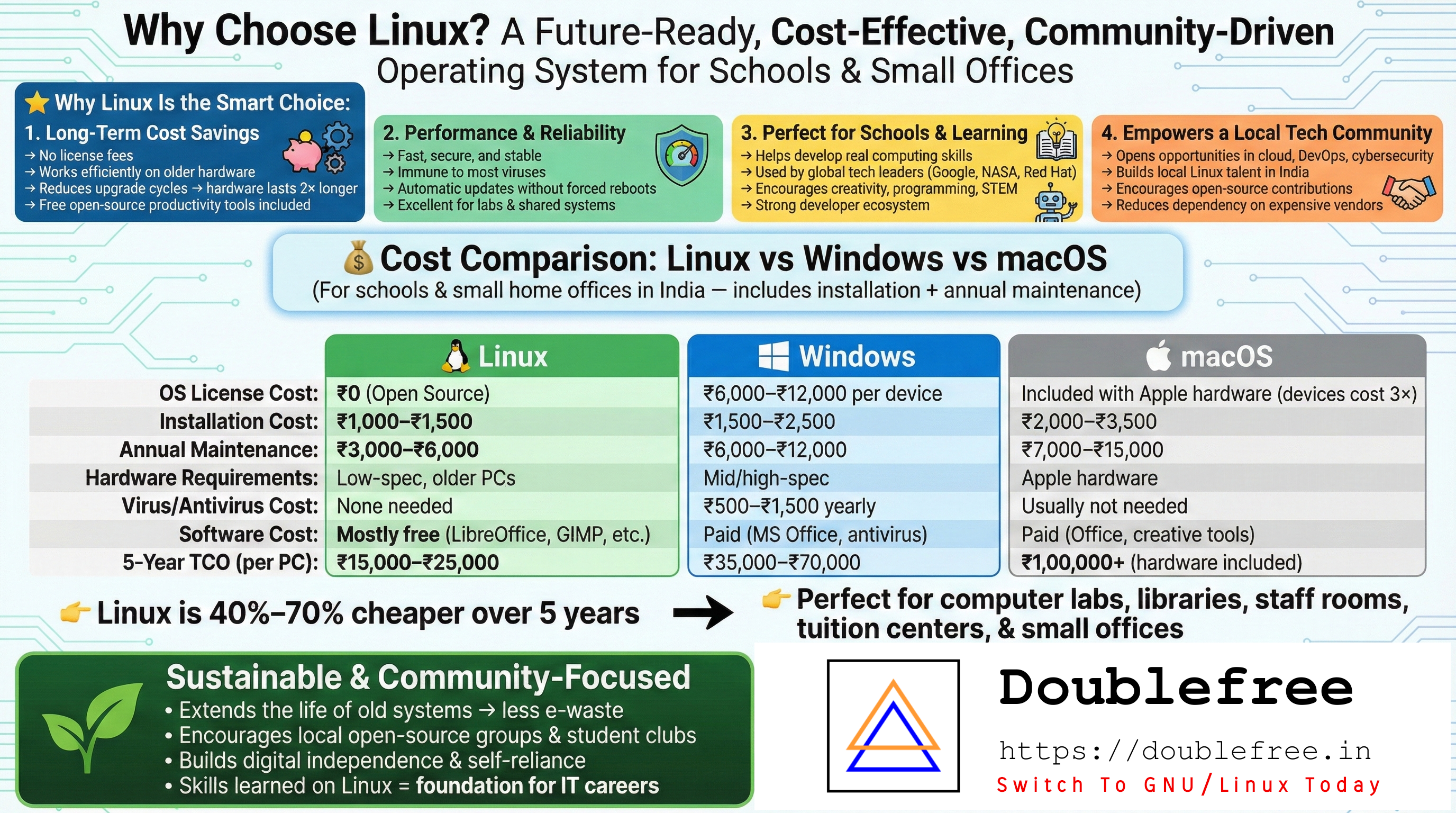
    <img src="/assets/images/SwitchToLinux.png" alt="Why Choose Linux? A future-ready, cost-effective, community-driven operating system for schools and small offices — poster with cost comparison of Linux, Windows, and macOS" />
</a></p>

<p>The poster above in plain text:</p>

<h2 id="why-linux-is-the-smart-choice">Why Linux Is the Smart Choice</h2>

<ol>
  <li><strong>Long-Term Cost Savings</strong> — no license fees, works efficiently on older
hardware, reduces upgrade cycles (hardware lasts 2× longer), free
open-source productivity tools included.</li>
  <li><strong>Performance &amp; Reliability</strong> — fast, secure, and stable; immune to most
viruses; automatic updates without forced reboots; excellent for labs and
shared systems.</li>
  <li><strong>Perfect for Schools &amp; Learning</strong> — helps develop real computing skills;
used by global tech leaders (Google, NASA, Red Hat); encourages
creativity, programming, and STEM; strong developer ecosystem.</li>
  <li><strong>Empowers a Local Tech Community</strong> — opens opportunities in cloud,
DevOps, and cybersecurity; builds local Linux talent in India; encourages
open-source contributions; reduces dependency on expensive vendors.</li>
</ol>

<h2 id="cost-comparison-linux-vs-windows-vs-macos">Cost Comparison: Linux vs Windows vs macOS</h2>

<p>For schools and small home offices in India — includes installation and
annual maintenance.</p>

<table>
  <thead>
    <tr>
      <th> </th>
      <th>Linux</th>
      <th>Windows</th>
      <th>macOS</th>
    </tr>
  </thead>
  <tbody>
    <tr>
      <td>OS License Cost</td>
      <td>₹0 (open source)</td>
      <td>₹6,000–₹12,000 per device</td>
      <td>Included with Apple hardware (devices cost 3×)</td>
    </tr>
    <tr>
      <td>Installation Cost</td>
      <td>₹1,000–₹1,500</td>
      <td>₹1,500–₹2,500</td>
      <td>₹2,000–₹3,500</td>
    </tr>
    <tr>
      <td>Annual Maintenance</td>
      <td>₹3,000–₹6,000</td>
      <td>₹6,000–₹12,000</td>
      <td>₹7,000–₹15,000</td>
    </tr>
    <tr>
      <td>Hardware Requirements</td>
      <td>Low-spec, older PCs</td>
      <td>Mid/high-spec</td>
      <td>Apple hardware</td>
    </tr>
    <tr>
      <td>Virus/Antivirus Cost</td>
      <td>None needed</td>
      <td>₹500–₹1,500 yearly</td>
      <td>Usually not needed</td>
    </tr>
    <tr>
      <td>Software Cost</td>
      <td>Mostly free (LibreOffice, GIMP)</td>
      <td>Paid (MS Office, antivirus)</td>
      <td>Paid (Office, creative tools)</td>
    </tr>
    <tr>
      <td>5-Year TCO (per PC)</td>
      <td><strong>₹15,000–₹25,000</strong></td>
      <td>₹35,000–₹70,000</td>
      <td>₹1,00,000+ (hardware included)</td>
    </tr>
  </tbody>
</table>

<p><strong>Linux is 40%–70% cheaper over 5 years</strong> — perfect for computer labs,
libraries, staff rooms, tuition centers, and small offices.</p>

<h2 id="sustainable--community-focused">Sustainable &amp; Community-Focused</h2>

<ul>
  <li>Extends the life of old systems → less e-waste</li>
  <li>Encourages local open-source groups and student clubs</li>
  <li>Builds digital independence and self-reliance</li>
  <li>Skills learned on Linux are a foundation for IT careers</li>
</ul>

<h3 id="related">Related</h3>

<ol>
  <li><a href="/education/freedom/why-gnu-linux-in-schools/">Why Schools Should Teach GNU/Linux</a></li>
  <li><a href="/technology/WhyDesktop/">Doublefree Free-Repairable Desktop</a></li>
</ol>]]></content><author><name>Doublefree Team</name><email>doublefreein+join@gmail.com</email></author><category term="Freedom" /><category term="Free-Software" /><summary type="html"><![CDATA[One poster, one message: it's time to switch to GNU/Linux.]]></summary></entry><entry><title type="html">Doublefree Free-Repairable Desktop</title><link href="https://doublefree.in/technology/WhyDesktop/" rel="alternate" type="text/html" title="Doublefree Free-Repairable Desktop" /><published>2025-08-24T00:00:00+00:00</published><updated>2025-08-24T00:00:00+00:00</updated><id>https://doublefree.in/technology/WhyDesktop</id><content type="html" xml:base="https://doublefree.in/technology/WhyDesktop/"><![CDATA[<h2 id="the-philosophy-freedom-repairability-and-long-term-thinking">The Philosophy: Freedom, Repairability, and Long-term Thinking</h2>

<p>In a world where technology is increasingly disposable and locked-down, the
Doublefree Free-Repairable Desktop represents a fundamental shift in how we
think about computing. Our philosophy is built on four core principles that
challenge the status quo.</p>

<h3 id="1-user-freedom-first">1. User Freedom First</h3>
<p>We believe that when you buy a computer, you should own it completely. Not just
the hardware, but the software that runs on it. That’s why we commit to 100%
Free Software wherever possible, with transparent documentation when proprietary
components are unavoidable. This isn’t just about ideology - it’s about ensuring
that every user, from students to small business owners, has the right to
understand, modify, and control their computing experience.</p>

<h3 id="2-repairability-as-a-human-right">2. Repairability as a Human Right</h3>
<p>Modern computers are designed to be replaced, not repaired. This creates a cycle
of waste and dependency that hurts both wallets and the environment. Our
desktops use standard PC components that can be opened with a simple
screwdriver, with modular design that allows individual parts to be upgraded or
replaced. When a student’s computer breaks, they shouldn’t have to throw it
away - they should be able to learn how to fix it.</p>

<h3 id="3-long-term-value-over-short-term-savings">3. Long-term Value Over Short-term Savings</h3>
<p>We’re building computers that last 10+ years, not 2-3 years. This means
choosing components that can be upgraded over time - adding more RAM, swapping out
storage, or even upgrading the CPU while keeping the same case and power supply.
It’s an investment in the future, not a disposable expense.</p>

<h3 id="4-education-through-technology">4. Education Through Technology</h3>
<p>Every Doublefree desktop is a learning platform. Students don’t just use these
machines - they understand them. From hardware basics to Linux internals, these
computers teach digital literacy in the deepest sense. They’re not just tools
for consumption, but platforms for creation and understanding.</p>

<hr />

<h2 id="why-bharat-needs-this-now">Why Bharat Needs This Now</h2>

<h3 id="the-digital-divide-reality">The Digital Divide Reality</h3>

<p>India’s digital transformation is happening at breakneck speed, but it’s
creating a dangerous divide. While urban areas get access to the latest
technology, rural schools and small businesses are left with either nothing or
substandard, locked-down devices that become obsolete within years. This isn’t
just about access - it’s about creating a sustainable foundation for digital
literacy.</p>

<h3 id="the-economic-imperative">The Economic Imperative</h3>

<p>Consider this: A typical school computer lab of 20 machines costs ₹6-8 lakhs
initially, but then requires complete replacement every 3-4 years. That’s
another ₹6-8 lakhs every few years, forever. Our approach? Start with ₹4-5 lakhs
for 20 machines, then spend ₹1-2 lakhs every 5-7 years on strategic upgrades.
Over a decade, that’s a savings of ₹15-20 lakhs - money that can go toward
teachers, curriculum, or expanding access to more students.</p>

<h3 id="made-in-bharat-for-bharat">Made in Bharat, For Bharat</h3>

<p>We’re not just importing solutions - we’re building them here. By prioritizing
India-assembled components and working with local vendors, we’re creating jobs
and building local expertise. When a computer breaks in a village school, the
solution shouldn’t require shipping it to another country. It should be fixable
by local technicians using locally available parts.</p>

<h3 id="the-skills-gap-crisis">The Skills Gap Crisis</h3>

<p>India needs millions of software developers, system administrators, and digital
creators. But how can students learn these skills on locked-down, proprietary
systems? Our desktops run Debian Linux - the same operating system that powers
most of the internet, from Google to Netflix. Students learn on the same tools
that professionals use, creating a direct pipeline from education to employment.</p>

<h3 id="environmental-responsibility">Environmental Responsibility</h3>

<p>Electronic waste is a global crisis, and developing countries often bear the
brunt of it. By building repairable, upgradable computers, we’re not just saving
money - we’re saving the planet. Every component that gets reused is one less
piece of e-waste poisoning our soil and water.</p>

<hr />

<h2 id="the-technical-foundation">The Technical Foundation</h2>

<h3 id="debian-linux-the-power-of-community">Debian Linux: The Power of Community</h3>

<p>We chose Debian not just because it’s free, but because it’s the most stable,
secure, and well-maintained Linux distribution in the world. With over 1,000
volunteer developers and 30+ years of development, Debian represents the best of
what open collaboration can achieve. When students use Debian, they’re learning
on a platform that powers everything from NASA missions to the International
Space Station.</p>

<h3 id="hardware-that-grows-with-you">Hardware That Grows With You</h3>

<p>Our three-tier approach (Ultra-Budget, Student Essential, and Power Student/SMB)
ensures that every organization can start where they are and grow from there. A
Tier 0 machine can be upgraded to Tier 1 performance by adding RAM and storage,
and eventually to Tier 2 by upgrading the motherboard and CPU - all while keeping
the same case, power supply, and peripherals.</p>

<h3 id="security-through-transparency">Security Through Transparency</h3>

<p>Unlike proprietary systems where security is a black box, our open-source
approach means that security researchers, educators, and students can all
examine the code for vulnerabilities. This creates a more secure system, not a
less secure one. When security issues are found, they can be fixed immediately
by the community, not when a corporation decides to release a patch.</p>

<hr />

<h2 id="the-road-ahead">The Road Ahead</h2>

<h3 id="immediate-impact">Immediate Impact</h3>
<ul>
  <li>We are looking for schools &amp; small business for pilot deployments</li>
  <li>We are also seeking local assembly partnerships with Indian manufacturers</li>
  <li>We want to initiate a training programs for technicians and educators</li>
</ul>

<hr />

<h2 id="join-the-movement">Join the Movement</h2>

<p>The Doublefree Free-Repairable Desktop isn’t just a product - it’s a movement. A
movement toward technology that serves people, not corporations. Toward
education that empowers, not just trains. Toward a future where every student,
every small business owner, and every citizen has access to computing that they
can understand, control, and repair.</p>

<p>This is the future Bharat needs. Not just to catch up with the developed world,
but to leap ahead by building technology that’s more sustainable, more
educational, and more human.</p>

<p><em>Ready to be part of the change? [doublefreein@gmail.com] to learn more about
pilot deployments, partnership opportunities, or how you can contribute to
building a more free and repairable digital future.</em></p>

<hr />

<p><em>This blog post is licensed under Creative Commons BY-SA 4.0. Feel free to
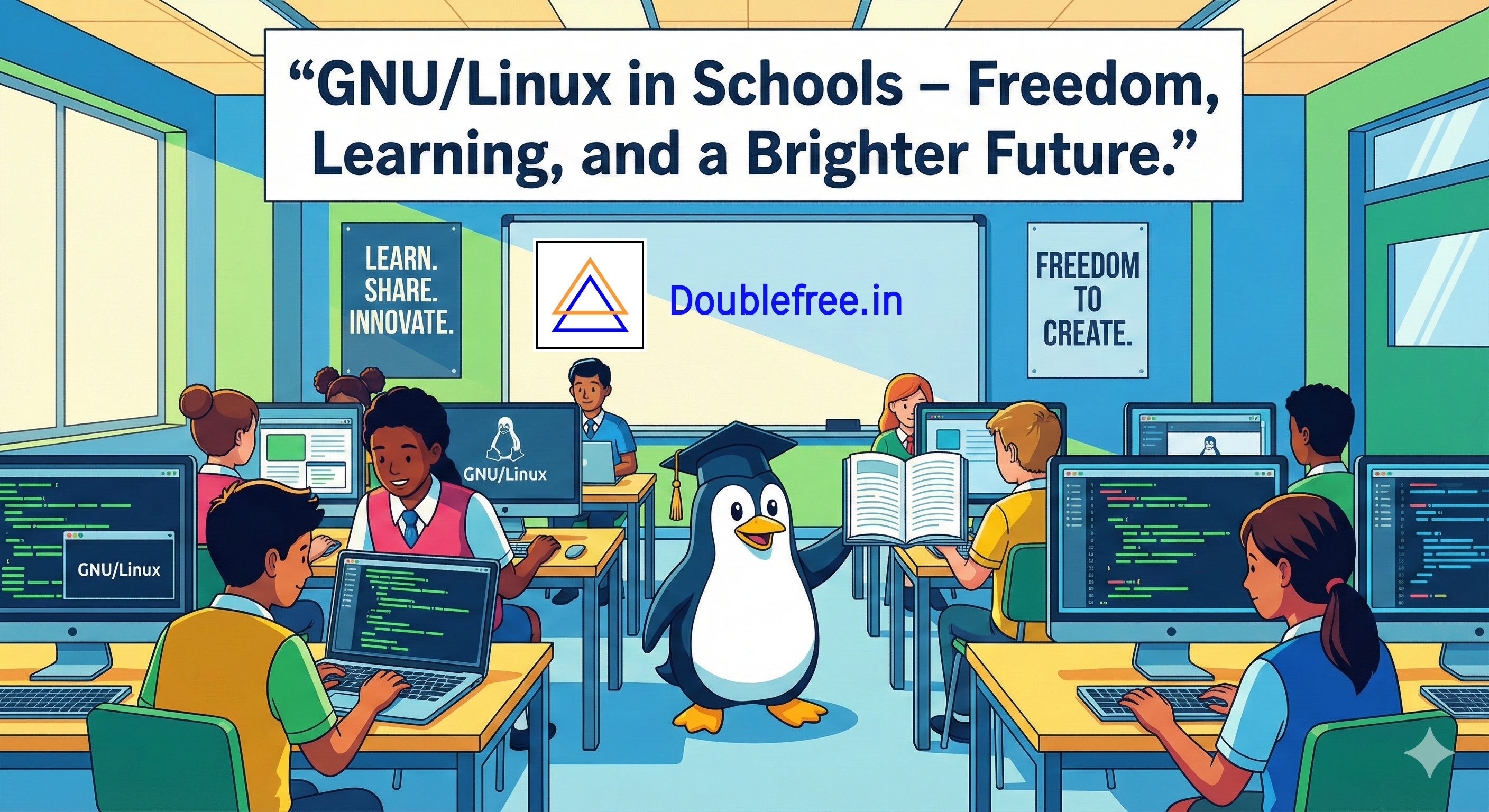
share, remix, and build upon it.</em></p>]]></content><author><name>Doublefree Team</name><email>doublefreein+join@gmail.com</email></author><category term="Technology" /><category term="Freedom" /><category term="Repairability" /><category term="Long-Term Thinking" /><summary type="html"><![CDATA[Why the Doublefree Free-Repairable Desktop is the future Bharat needs.]]></summary></entry><entry><title type="html">Why Schools Should Teach GNU/Linux - Not Proprietary OSes</title><link href="https://doublefree.in/education/freedom/why-gnu-linux-in-schools/" rel="alternate" type="text/html" title="Why Schools Should Teach GNU/Linux - Not Proprietary OSes" /><published>2025-08-10T00:00:00+00:00</published><updated>2025-08-10T00:00:00+00:00</updated><id>https://doublefree.in/education/freedom/why-gnu-linux-in-schools</id><content type="html" xml:base="https://doublefree.in/education/freedom/why-gnu-linux-in-schools/"><![CDATA[<p><img src="/assets/images/LinuxInSchools.png" alt="GNU/Linux in schools" /></p>

<p>In today’s AI-hungry, “freebie” world, we’ve learned to measure software only by how comfortable it feels, not by how free it makes us. The irony? We’ve traded actual freedom for a frictionless login screen and a pretty wallpaper.</p>

<p>When schools introduce children to technology through proprietary operating systems, they’re not just teaching “how to use a computer.” They’re silently setting the rules:</p>

<p>You don’t control the machine - the vendor does.</p>

<p>Your files, your choices, and sometimes your very access are conditional on terms you didn’t write.</p>

<p>Convenience &gt; autonomy.</p>

<p>Many big tech companies now offer hardware and software to schools for free of charge — gratis, not libre. To budget-strapped institutions, this looks like a win: no license costs, no capital expenditure. But there’s a long game here. Students spend years on these machines, learning within these ecosystems, building habits around these tools. By the time they graduate and move into their careers, their “obvious” choice will be the same proprietary stack they were trained on in school. Vendor lock-in doesn’t always start in the office — it often starts in the classroom.</p>

<p>It’s not about “user-friendly” vs “complicated.” Freedom is not always comfortable. It is messy, requires responsibility, and asks you to understand the thing you’re using. But it is also what prevents the tools of learning from becoming tools of control.</p>

<p>GNU/Linux is not perfect, but it is one of the few spaces where you can read the code, change it, share it, and keep it forever — without asking permission. And that’s exactly why it belongs in the classroom.</p>

<p>It doesn’t have to be a glassy UI with animated icons. Start with the black screen, the CLI, the raw commands. Show kids what ls does, what a file system looks like, how to write a simple script. Teach them that computers are not magic boxes; they are logical machines they can shape, break, and fix.</p>

<p>Because in the coming years, the cost of ignoring freedom will not just be an ad in your inbox. It will be AI systems you can’t question, platforms you can’t leave, and “free” tools that own more of you than you own of them.</p>

<p>Better to raise a generation who knows that software is not a service - it’s theirs.</p>

<hr />

<p>Explore <a href="https://github.com/doublefreein/Doublefree-s-GNU-Linux-Education-Program">Doublefree’s GNU/Linux Education Program</a>
– A comprehensive educational curriculum for introducing high school students to GNU/Linux operating system and its philosophy.</p>]]></content><author><name>Doublefree Team</name><email>doublefreein+join@gmail.com</email></author><category term="Education" /><category term="Freedom" /><category term="Free-Software" /><summary type="html"><![CDATA[When schools teach proprietary systems, they teach dependence. GNU/Linux belongs in the classroom.]]></summary></entry><entry><title type="html">Mud, Soil &amp;amp; Lime</title><link href="https://doublefree.in/sustainability/MudSoilLime/" rel="alternate" type="text/html" title="Mud, Soil &amp;amp; Lime" /><published>2025-02-20T00:00:00+00:00</published><updated>2025-02-20T00:00:00+00:00</updated><id>https://doublefree.in/sustainability/MudSoilLime</id><content type="html" xml:base="https://doublefree.in/sustainability/MudSoilLime/"><![CDATA[<p>Traditional construction techniques have stood the test of time, offering
durability, climate adaptability, and sustainability. Many ancient 
methods - like lime plastering, rammed earth walls, and stone masonry—are 
not only environmentally friendly but also cost-effective in the long run.</p>

<p>Reviving these techniques can help reduce dependence on modern 
energy-intensive materials like cement and steel, leading to more 
decentralized and resilient communities. It’s crucial to document, 
practice, and teach these methods to ensure they are not lost to 
future generations.</p>

<p>The houses built with mud/soil &amp; lime are</p>

<ol>
  <li>Eco friendly
    <ol>
      <li>Unlike Cement, it has very low carbon footprint</li>
      <li>Not an product of factory</li>
      <li>Transportation emission cost</li>
    </ol>
  </li>
  <li>Energy efficient
    <ol>
      <li>Mud walls have high thermal mass, cooler in summer &amp; warmer in winter</li>
      <li>Breathable: Lime allows walls to breath, preventing moisture buildup and
improving indoor air quality.</li>
      <li>Lower Energy Bills</li>
    </ol>
  </li>
  <li>Cost Effectiveness
    <ol>
      <li>Cement &amp; steel are costlier</li>
      <li>Properly built mud-lime structures require little maintenance and last
for generations.</li>
    </ol>
  </li>
  <li>Aesthetic &amp; Cultural Value
    <ol>
      <li>Such buildings have a timeless, earthy look that blends with nature.</li>
    </ol>
  </li>
</ol>

<p>Here are some beautiful structures build using soil &amp; lime.</p>

<ul>
  <li><a href="https://www.earth-auroville.com/">Auroville Earth Institute</a></li>
  <li><a href="https://hunnarshala.org/">Hunnarshala Foundation</a></li>
</ul>

<p>There are different methods of construction using mud, soil, clay &amp; lime.</p>

<p>A. Traditional Mud Construction</p>
<ul>
  <li><em>Cob Construction</em>: A mix of clay, sand, straw, and water is molded by hand and
built up in layers. This method creates strong, sculptural walls.
    <ul>
      <li><img src="/assets/images/mud/cob.png" height="200" alt="Cob construction: hand-molded clay, sand, and straw walls" /></li>
      <li><a href="https://en.wikipedia.org/wiki/Cob_(material)">source</a></li>
    </ul>
  </li>
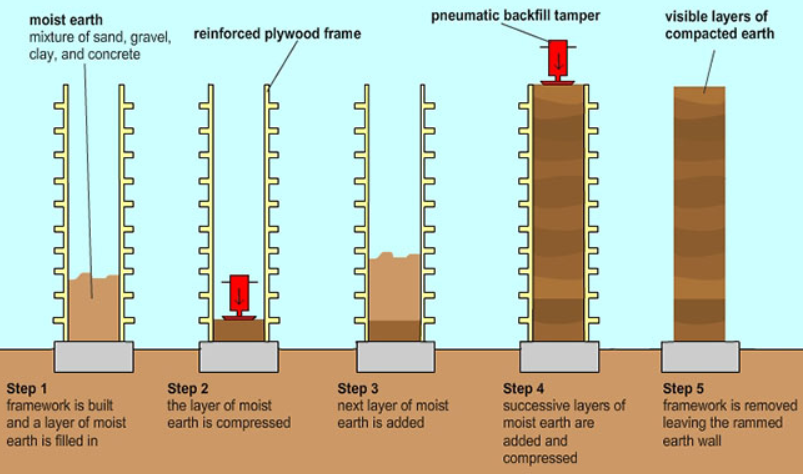
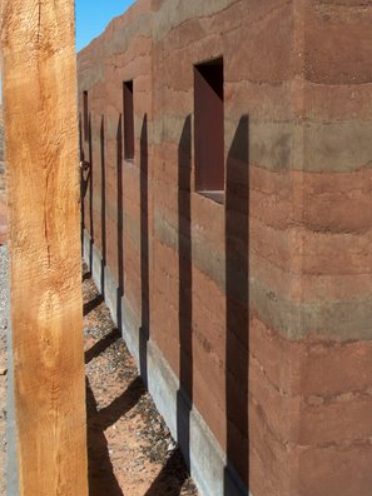
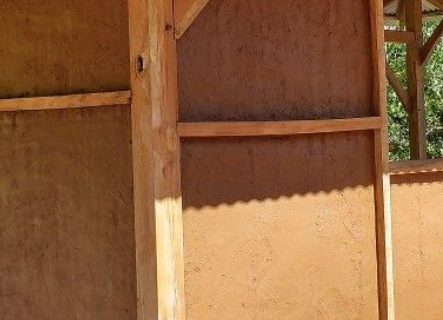
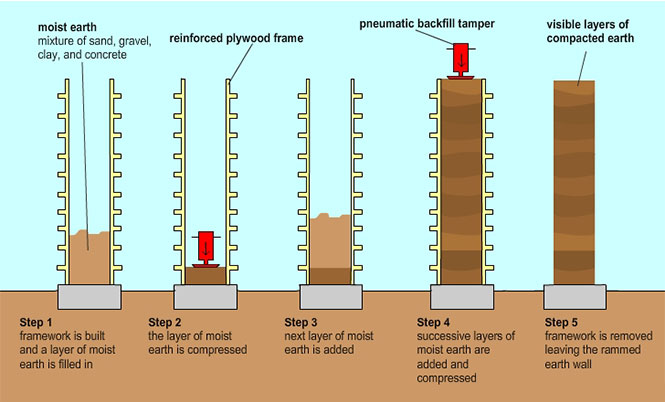
  <li><em>Rammed Earth</em>: Layers of damp soil are compacted within a temporary frame,
creating solid and durable walls.
    <ul>
      <li><img src="/assets/images/mud/rammed.png" height="200" alt="Rammed earth technique: soil compacted in a temporary frame" /><img src="/assets/images/mud/rammed1.png" height="200" alt="Finished rammed earth wall showing layered texture" /></li>
      <li><a href="https://www.greenspec.co.uk/images/web/materials/rammedearth/rammed-earth-technique.jpg">source</a></li>
    </ul>
  </li>
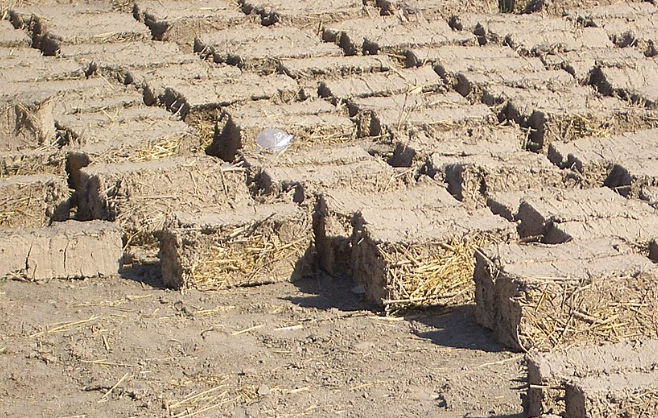
  <li><em>Adobe Bricks</em>: Sun-dried mud bricks are stacked with a mud-lime mortar,
providing stability and breathability.
    <ul>
      <li><img src="/assets/images/mud/adobe.png" height="200" alt="Adobe construction: sun-dried mud bricks stacked with mortar" /></li>
      <li><a href="https://en.wikipedia.org/wiki/Adobe">source</a></li>
    </ul>
  </li>
  <li><em>Wattle and Daub</em>: A woven lattice of wooden strips is coated with a mud-lime
mixture, offering flexibility and earthquake resistance.
    <ul>
      <li><img src="/assets/images/mud/wattleDaub.png" height="200" alt="Wattle and daub: woven wooden lattice coated with mud-lime mix" /></li>
      <li><a href="https://i.pinimg.com/originals/83/ab/16/83ab1653466445712f3b822df5a79c98.jpg">source</a></li>
    </ul>
  </li>
</ul>

<p>B. Lime Integration for Durability</p>
<ul>
  <li><em>Lime Stabilization</em>: Lime is mixed with soil to improve strength, water
resistance, and longevity.</li>
  <li><em>Lime Plaster &amp; Wash</em>: Applied to walls for weather protection, pest resistance,
and a breathable finish.</li>
  <li><em>Limecrete Flooring</em>: An alternative to cement floors, providing insulation and
moisture control.</li>
</ul>

<h4 id="case-studies-from-india">Case Studies From India</h4>
<ol>
  <li><em>Hunnarshala Foundation, India</em>
    <ul>
      <li>This organization has revived traditional mud and lime techniques,
successfully building homes in earthquake-prone regions like Kutch, Gujarat.</li>
      <li>They use stabilized adobe and rammed earth for long-lasting, low-cost homes.</li>
      <li><a href="https://www.re-thinkingthefuture.com/sustainable-architecture/a7329-hunnarshala-foundation-pioneering-sustainable-architecture-of-regional-india/">Website</a></li>
    </ul>
  </li>
  <li><em>Auroville Earth Institute, Tamil Nadu, India</em>
    <ul>
      <li>Focuses on sustainable building using compressed stabilized earth blocks
(CSEB) with lime.</li>
      <li>Their projects demonstrate how modern aesthetics and traditional techniques
can blend seamlessly.</li>
      <li><a href="https://auroville.org/page/earth-institute">Website</a></li>
    </ul>
  </li>
</ol>

<hr />]]></content><author><name>Doublefree Team</name><email>doublefreein+join@gmail.com</email></author><category term="Sustainability" /><category term="Construction" /><category term="Building" /><category term="Soil" /><category term="Lime" /><summary type="html"><![CDATA[Traditional construction with mud, soil, and lime is durable, climate-adaptive, and sustainable — and worth reviving.]]></summary></entry><entry><title type="html">Decentralization - Why It’s the Need of the Hour</title><link href="https://doublefree.in/technology/Decentralization/" rel="alternate" type="text/html" title="Decentralization - Why It’s the Need of the Hour" /><published>2024-11-18T00:00:00+00:00</published><updated>2024-11-18T00:00:00+00:00</updated><id>https://doublefree.in/technology/Decentralization</id><content type="html" xml:base="https://doublefree.in/technology/Decentralization/"><![CDATA[<p>Looking back at the events of the past decade, one can’t help but wonder:</p>

<ul>
  <li>What will the future look like for us as individuals?</li>
  <li>Where is our society headed by 2050?</li>
</ul>

<h3 id="the-technological-tides-that-shape-us">The Technological Tides That Shape Us</h3>

<p>Human history has been continuously shaped by groundbreaking inventions. From
the printing press to gunpowder, each innovation disrupted the status quo,
leaving an indelible mark not only on its creators but on the entire world.</p>

<p>The past two decades have been dominated by the rise of information
technology—transitioning from dot-coms to cloud computing, from telephones to
mobile devices, and now to wearables. Unlike earlier innovations that took time
to spread through communities and countries, today’s advancements spread at the
speed of light.</p>

<p>Take ChatGPT, for instance: an AI tool available to anyone, anywhere in the
world. The globe has truly become a village, connected in ways unimaginable
before.</p>

<h3 id="the-growing-grip-of-big-tech">The Growing Grip of Big Tech</h3>

<p>This hyper-connectivity has its downsides. A handful of tech giants now wield
unparalleled power. For instance, companies like Google and Meta (formerly
Facebook), though headquartered in the USA, operate globally, from Europe and
Asia to Africa and even Antarctica.</p>

<p>Their scale enables them to invest in massive research and innovation, creating
barriers for smaller players or startups. As a result, the global market risks
turning into a monopoly controlled by a few corporate giants.</p>

<p>Governments in some regions, being over powered by them, have opted for
partnerships between big tech and local players. For example, Google and Meta
have invested in Jio in India, leveraging its local presence to tap into the
vast consumer base.</p>

<h3 id="the-ripple-effect-on-society">The Ripple Effect on Society</h3>

<p>The effects of centralization extend far beyond technology:</p>

<ul>
  <li><strong>Education and Learning</strong>: Traditional knowledge-based education systems are
losing relevance in a world where information is instantly accessible. The
challenge now is to equip individuals with skills that foster critical
thinking, creativity, collaboration and the change. (4 Cs).</li>
  <li><strong>Agriculture and Automation</strong>: With advances in robotics and drone
technology, farming could become fully automated, leading to cheaper produce.
However, this would displace small-scale farmers and render large sections of
the workforce economically redundant, shifting their roles from producers to
mere consumers.</li>
  <li><strong>Economic Inequality</strong>: Capitalism, while driving innovation, has
concentrated wealth in the hands of a few. This profit-driven model risks
alienating the lower strata of society, turning them into pawns in a
centralized, monolithic economy.</li>
</ul>

<h3 id="a-call-for-decentralization">A Call for Decentralization</h3>

<p>This isn’t a battle against technology or corporations—it’s a challenge to the
centralization model that further worsen the inequality and discards grassroots
participation. For more ore inclusive future, we must:</p>

<h4 id="1-break-centralization-and-embrace-decentralization">1. <strong>Break Centralization and Embrace Decentralization</strong></h4>

<p>Promote businesses and solutions that are decentralized by design, fostering
diversity and resilience in the economy.</p>

<h4 id="2-champion-open-source-and-open-architecture">2. <strong>Champion Open Source and Open Architecture</strong></h4>

<p>Support open-source initiatives that prioritize transparency and collaboration.
Open architectures encourage innovation by allowing contributions from
individuals and communities worldwide.</p>

<h4 id="3-encourage-local-production">3. <strong>Encourage Local Production</strong></h4>

<p>While locally produced goods may be costlier or lack uniform quality, supporting
them is a responsibility. It sustains local economies and reduces reliance on
monopolistic global supply chains.</p>

<h4 id="4-raise-awareness-and-build-skills">4. <strong>Raise Awareness and Build Skills</strong></h4>

<p>Decentralization is not the easy path—it requires effort, grit, and an
understanding of its importance. Education plays a vital role in raising
awareness and equipping individuals with the skills needed to thrive in a
decentralized world.</p>

<h3 id="finding-balance">Finding Balance</h3>

<p>The goal is not to reject progress but to ensure that technological advancements
coexist with respect for humanity and equity. True progress lies in balancing
innovation with compassion, enabling every individual to lead a meaningful life.</p>

<p>The nationalist approach to addressing this issue is straightforward in theory:
clone, adapt, or learn from the global giants and reverse-engineer their
solutions to fit the needs of a specific nation. However, this is far easier
said than done. The global market operates on systems that have evolved
organically over time, rather than being explicitly designed. As a result,
reverse-engineering these complex structures is highly challenging and requires
significant talent and resources.</p>

<p>The decentralize models is beyond a nation even suited for Vasudhaiv Kutumbakam.</p>

<div class="language-plaintext highlighter-rouge"><div class="highlight"><pre class="highlight"><code>अयं निजः परो वेति गणना लघुचेतसाम्।
उदारचरितानां तु वसुधैव कुटुम्बकम्॥
</code></pre></div></div>

<p>The future is ours to shape—let’s decentralize it.</p>]]></content><author><name>Doublefree Team</name><email>doublefreein+join@gmail.com</email></author><category term="Technology" /><category term="Decentralization" /><summary type="html"><![CDATA[Technology is centralizing power at unprecedented speed. Decentralization is how we take it back.]]></summary></entry></feed>