Public Tech Should Be Publicly Built
Why India must choose open source for its government infrastructure — and how it could become the largest employer of engineers in the AI era.
01 / The Problem — The Government Pays. Someone Else Owns It.
Every time a state department signs a contract with a large IT vendor, something strange happens: taxpayer money funds the creation of software that the public can never see, audit, modify, or reuse. When the contract ends, that software either gets abandoned, or the government is held hostage to renew at inflated prices.
This is not just a financial inefficiency. It is a sovereignty problem. India’s railways, tax systems, land records, health portals, education platforms — these are the arteries of a nation. And most of them run on code written by corporations whose first obligation is to shareholders, not citizens.
“If public money built it, the public should own it. That’s not a radical idea — it’s basic accountability.”
The irony is that India already has proof this works. Aadhaar, UPI, DigiLocker, COWIN — each of these was built with significant open or interoperable architecture. UPI became the world’s largest real-time payment system not because one vendor owned it, but because anyone could build on it.
02 / The AI Threat to Private Employment — AI Is Writing the Code. Engineers
Are Losing the Work.
Until recently, India’s tech employment boom was driven by services: Indian engineers building software for foreign corporations. Infosys, TCS, Wipro, HCL — the model was straightforward. Large companies in the US or Europe outsource development work to Indian talent. It created millions of jobs and built a middle class in cities like Bengaluru, Hyderabad, Pune, and Chennai.
That model is cracking. Not because Indian engineers aren’t good — they are — but because AI coding tools like GitHub Copilot, Cursor, and increasingly autonomous agents are compressing the labour required for routine development work by an order of magnitude. A task that once required a team of 10 can now be done by 2 engineers with the right AI tooling.
This is not speculation. Major IT services companies have already begun reducing headcount in their junior and mid-level engineering pipelines. Freshers are finding fewer campus placements. The outsourcing model that built modern India’s tech economy is structurally challenged — and no private firm is going to absorb the surplus talent.
Status Quo vs. Open Source Public Tech
| Status Quo | Open Source Public Tech | |
|---|---|---|
| Ownership | Vendor owns the code | Government owns and controls code |
| Cost | Vendor lock-in & opaque pricing | Reusable across all 28+ states |
| Employment | AI shrinks private sector hiring | Creates stable public employment |
| Duplication | Each dept. rebuilds the same solutions | Single codebase, adapted by every state |
| Ecosystem | No local skill base developed | Grows a sovereign tech talent base |
| Transparency | Closed, unauditable systems | Full transparency & public auditability |
03 / The Opportunity — Public Infrastructure Is the Largest Unbuilt Codebase
in the World
Consider the sheer surface area of what needs to be built, maintained, and improved in a country of 1.4 billion people:
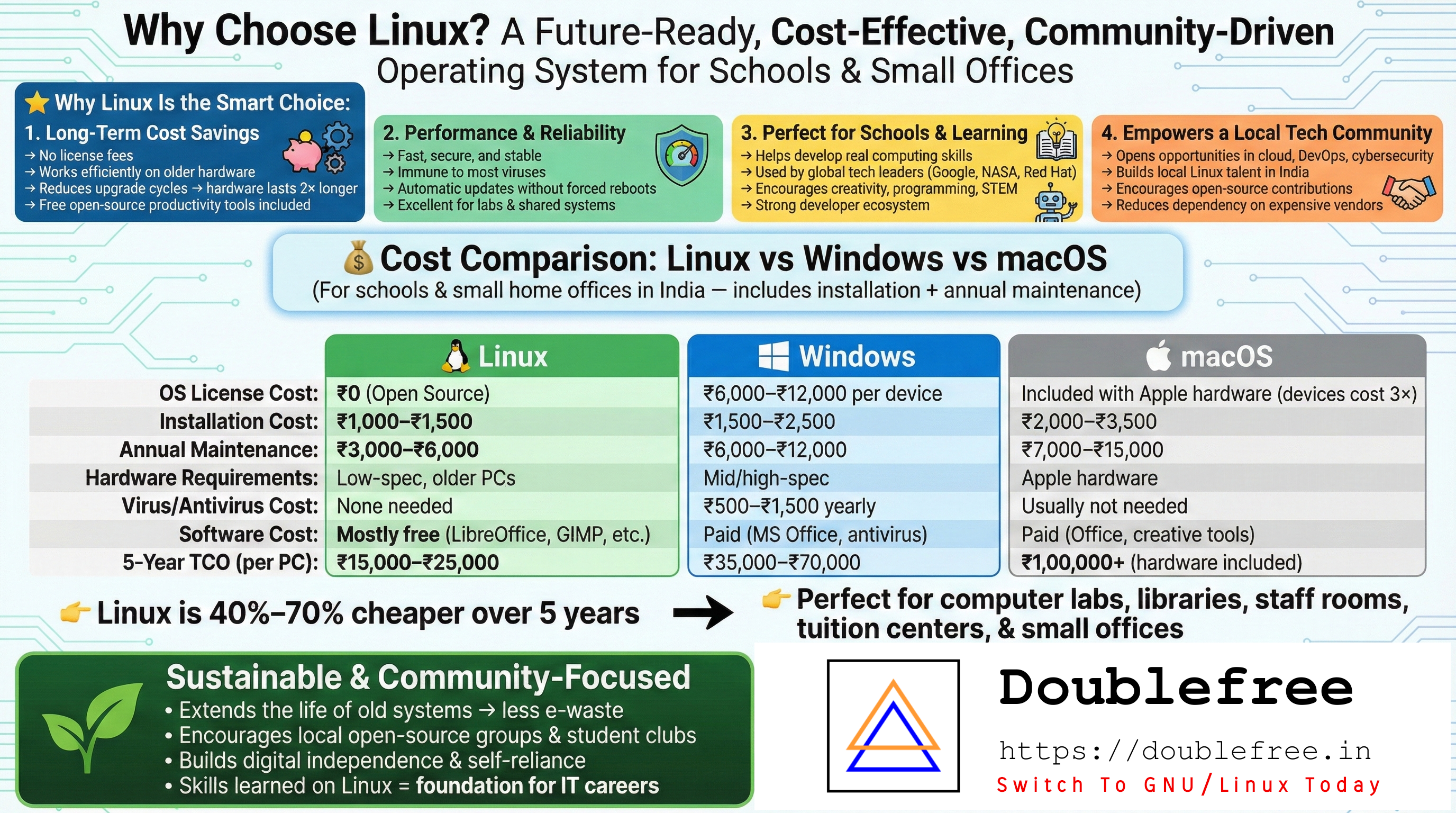
Operating Systems & Core Infrastructure A sovereign Indian Linux distribution for government use — secure, auditable, maintained by Indian engineers. Not Windows licenses paid to Microsoft in perpetuity.
Health & Records Ayushman Bharat needs open, interoperable Electronic Health Record (EHR) software deployed across 1.5 lakh+ health centres. A massive, ongoing engineering effort.
Education Platforms DIKSHA and similar platforms need feature development, regional language support, offline capability, and accessibility tooling — for 250 million+ students.
Land & Civic Systems Land records, municipal services, ration distribution, court management — most states have isolated, aging systems. Open reimplementation is long overdue.
Cybersecurity Stack India needs open-source security tooling, intrusion detection, and SOC infrastructure that isn’t dependent on US or Israeli vendors with their own geopolitical interests.
AI & Data Infrastructure Public AI models trained on Indian languages. Open datasets. Government compute infrastructure. The alternative is permanent dependency on foreign cloud giants.
None of this can be built once and forgotten. Software requires continuous maintenance, security patching, feature additions, localisation, and performance tuning. This is permanent work — the kind that creates careers, not contracts.
04 / The Employment Model — What Does “Open Source Public Tech Employment”
Actually Look Like?
This is not about creating government babus who push code reviews for 30 years. It is about a new class of civic technologist — engineers employed by India’s states and central government to build, maintain, and govern public digital infrastructure, in the open.
| # | Role | What They Do | Demand |
|---|---|---|---|
| 01 | Core Platform Engineers | Build & maintain foundational public infra: OS, cloud, identity, payments | High |
| 02 | Domain Application Developers | Health, education, agriculture, judiciary — sector-specific software teams | High |
| 03 | State-Level Deployment Engineers | Each state adapts & deploys central open source platforms locally | High (28+ states) |
| 04 | Security & Audit Engineers | Open code must be publicly auditable — dedicated security teams needed | Specialist |
| 05 | Localisation Engineers | 22 official languages, hundreds of dialects — language & accessibility work | Specialist |
| 06 | AI & Data Engineers | Public LLMs, open datasets, government AI services in Indian languages | Emerging |
| 07 | Open Source Community Managers | Coordinate contributors, manage public repos, documentation, governance | New role |
Multiply each of these roles across 28 states, 8 union territories, hundreds of central ministries and departments, and the employment potential runs into the hundreds of thousands of engineers — stable, mission-driven work that no AI can simply offshore.
05 / India Already Has a Head Start — The Precedents Are Right Here
India has repeatedly demonstrated that state-built open platforms can outcompete private solutions at scale. The Digital Public Infrastructure (DPI) stack is a global case study in what’s possible.
2009–2016 — Aadhaar Built with open APIs and interoperable design. 1.3 billion enrollments. Created an entire ecosystem of engineers, integrators, and builders around a single public identity platform.
2016 — UPI Goes Live Open interoperable payments infrastructure. Today processes 13 billion+ transactions per month. Spawned PhonePe, Google Pay, Paytm, and thousands of fintech jobs — all on top of a public foundation.
2017 — DIKSHA Education Platform Open source ed-tech platform now used by all states. Proof that a central open codebase can be adapted by every state without reinventing the wheel.
2020 — COWIN Vaccination Platform Built, scaled, and open-sourced. India vaccinated 2 billion+ doses, managed via a system that was then offered to other nations for free. Built by Indians, for India, and shared with the world.
2023–Now — India Stack & DPI Exports Other countries are actively adopting India’s public tech playbook. The next phase: a domestic workforce that builds, exports, and sustains this infrastructure as a global product.
06 / The Counter-Arguments — What Critics Get Wrong
“Government can’t build good software.”
This was true when government meant waterfall contracts awarded to the lowest bidder. It doesn’t have to mean that. CERN built the web. NASA built Unix tools. Estonia built e-governance that runs an entire country on open digital infrastructure. The issue is procurement models and incentive structures, not some inherent incapacity in the public sector.
“It will be insecure — everyone can see the code.”
This is the security-through-obscurity fallacy, thoroughly debunked by decades of evidence. Open source software is more secure on average because vulnerabilities are spotted by a global community of researchers, not hidden until exploited by an adversary. Linux powers the internet. OpenSSL secures it. Android, which is open source, runs 3 billion phones. The argument doesn’t hold.
“Private firms are more efficient.”
Efficient at what? Extracting margin? Certainly. Building for the long-term public interest while remaining auditable, adaptable, and sovereign? The record is far murkier. When Healthcare.gov collapsed in the United States, it was built by 100% private contractors on closed systems. When COWIN scaled to manage the world’s largest vaccination drive, it was built in the public interest, with public accountability.
07 / The Path Forward — What Needs to Happen
This isn’t a dream — it’s a policy choice. Here is what it concretely requires:
“Public Money, Public Code” Mandate Any software funded by government procurement must be released as open source by default, with narrow, explicitly defined exceptions for genuine national security needs. This is already law in several European countries.
National Digital Service A GDS-style body (modelled on the UK’s Government Digital Service or the US’s 18F) that employs engineers directly to build and maintain core platforms, outside of standard procurement cycles.
State-Level Open Source Engineering Corps Each state funds a standing team of engineers who fork, adapt, and deploy central platforms for local needs — accountable to citizens and state legislatures, not to private vendors.
Civic Tech Curriculum IITs, NITs, and polytechnics introduce civic technology tracks. Contributing to public open source repositories counts toward academic credit. Engineers graduate with both technical skills and a sense of public mission.
The Bottom Line
AI is not going to spare Indian engineers from disruption just because they’re talented. The private sector is restructuring. The outsourcing model is contracting. The question isn’t whether the tech job landscape changes — it’s whether India builds an alternative or simply absorbs the shock.
Open source public infrastructure is that alternative. It creates work that is mission-driven, stable, sovereign, and resistant to being automated away entirely — because it requires contextual understanding of India’s languages, laws, systems, and citizens that no generic AI model has.
India built UPI. India built Aadhaar. India built COWIN. India can build the operating system of its own governance. And in doing so, it can put hundreds of thousands of engineers to work on something that will outlast any private contract — and belong to everyone.
If public money built it, the public should own it.

Licensed under Creative Commons Attribution-ShareAlike 4.0 International (CC BY-SA 4.0). Share and adapt freely — attribution required, same licence applies.
© 2026– doublefree.in